
Options, explained without the jargon
What a call and a put actually are, why the vocabulary is so hostile, and the specific ways beginners get hurt — written by someone not trying to sell you a strategy course.
Options have the worst explanatory literature in finance. Half of it is written for people who already understand them, and the other half is written by people selling a system, who need you excited rather than informed. The underlying idea is genuinely simple. The vocabulary is what is difficult, and the vocabulary is not the point.
The whole idea, in one paragraph
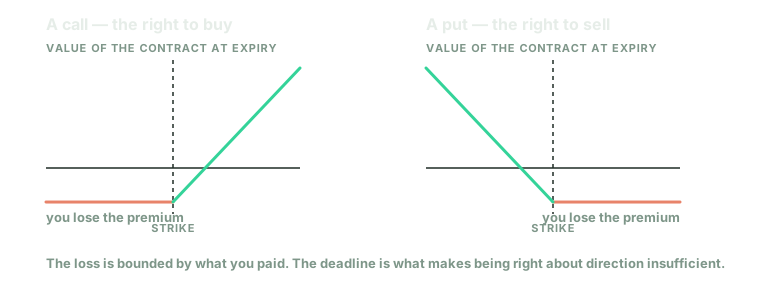
An option is a contract that gives you the right to buy or sell something at an agreed price by an agreed date — without obliging you to. You pay for that right up front. If the agreed price turns out to be attractive, you use it. If it does not, you let it expire and you have lost what you paid. That is the entire mechanism. A call is the right to buy at the agreed price; a put is the right to sell at it.
A worked comparison: a deposit that reserves a car at today's price for three months is a call. If the model becomes sought-after, your reservation is valuable. If the price falls, you walk away and lose the deposit. An insurance policy on the same car is a put — you pay a premium for the right to be made whole at an agreed value, and if nothing happens the premium is simply gone. Neither analogy is perfect, but both capture the structure that matters: a fee paid now for optionality later.
Why the words are so hostile
Four terms carry most of the confusion, and none of them is complicated once translated. The strike is the agreed price. Expiry is the deadline. The premium is what you paid. Being in the money means the agreed price is currently favourable — and being out of the money means it is not, which is a polite way of saying the contract is currently worth nothing at expiry.
The Greeks — delta, gamma, theta, vega — sound like the hard part and are mostly bookkeeping. They answer: how much does this move when the underlying moves, how fast does that sensitivity itself change, how much do I lose to the passage of time, and how much does it matter if the market gets more nervous. You do not need to compute them. You do need to know that all four are working on your position while you sleep.
The three ways beginners actually get hurt
Time runs out
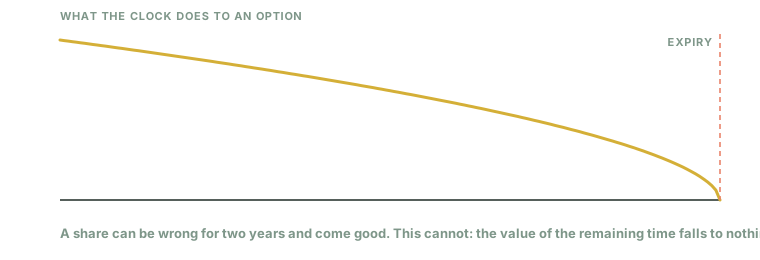
A share you own can be wrong for two years and still come good. An option cannot. Being right about direction and wrong about timing produces a total loss on the contract, which is the single most common beginner experience with options and the one least often mentioned in the advertising.
The leverage cuts the other way
Options are attractive because a small outlay controls a large exposure. That is the same sentence as: small moves against you destroy a large share of what you put in. Leverage is not a feature that improves outcomes — it widens them in both directions, and it does so faster than most people revise their thinking.
Selling what you cannot cover
Buying an option risks the premium. Selling one can obligate you to deliver, with losses that are not bounded by what you received. Strategies that sell options often produce many small gains and rare large losses, which reads as consistent success right up until the week it does not.
The third one deserves emphasis because it is where the marketing is most misleading. A strategy that wins most months and loses badly in rare conditions has a distribution, not a track record. Nassim Nicholas Taleb's Fooled by Randomness (2001) is a book-length treatment of exactly this error: judging a strategy by the outcomes that have happened rather than by the outcomes it can produce.
Where options are genuinely useful
None of the above means options are a trap. They are a tool with a legitimate original purpose: transferring risk from someone who does not want it to someone who will hold it for a fee. Used that way — reducing exposure, defining a maximum loss in advance, generating income against holdings you already own and are willing to part with — they do something no share position can.
Used as a cheaper way to make a large directional bet, they are simply leverage with a deadline attached. Both uses are available from the same screen, which is precisely why the distinction has to be made deliberately, before you open the ticket, and written down.
The regulatory framing is worth knowing too, because it is not marketing. Brokers are required to approve accounts for options by level, and the levels exist because the risks genuinely differ in kind — buying a call and selling an uncovered one are not two settings of the same dial. Options are formally recognised as unsuitable for some investors, which is a statement almost no other retail product carries.
How to learn them without paying tuition to the market
Read one contract end to end before trading any: what it entitles you to, on what date, at what price, and what the worst case is if you are entirely wrong. Then run it on paper — not for a week, but through an expiry, because expiry is when everything you did not think about arrives at once.
The Options Clearing Corporation publishes the standardised risk disclosure document that brokers are required to provide, and it is the least promotional thing written on the subject. It is not enjoyable reading. It is accurate, which the free webinars competing for your attention are not obliged to be.
Free PDF
Download this guide as a PDF
The payoff diagrams and the three ways beginners get hurt, in a form you can re-read before you open a ticket.
myMTree is a research and education platform operated by RV Technology Consulting LLC. This article is general educational information, not investment advice, and not a recommendation to buy or sell any security. It does not account for your circumstances, objectives, or risk tolerance. Investing involves risk, including the possible loss of principal; options carry additional risks and are not suitable for every investor. Consider speaking with a licensed financial adviser before making investment decisions.