
Risk management for people with a day job
Why every experienced trader talks about defence, what a rule is that an intention is not, and how to build one when you cannot watch the market.
Jack Schwager interviewed dozens of exceptional traders for Market Wizards (1989) and its sequels. They disagreed about nearly everything — timeframes, instruments, whether charts contain information at all. The agreement was about defence: position sizing, predefined exits, and the assumption that any given position might be wrong. Paul Tudor Jones described his own focus to Schwager as defensive rather than offensive.
That is a strange result if you expect expertise to be about picking well. It is an obvious one if you notice that picking well is not repeatable and not losing catastrophically is.
Why the arithmetic is not symmetrical
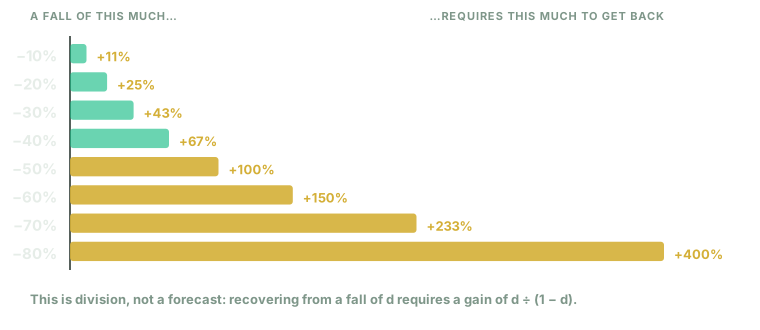
The reason defence dominates is mathematical rather than temperamental. Losses and gains do not cancel. A position that falls by half must double to return to where it began — the same percentage move in each direction leaves you behind. The deeper the loss, the more disproportionate the recovery required, which is why avoiding the large loss matters more than capturing the large gain.
This is also why an average return is a misleading way to describe a strategy that can go to zero. Taleb's argument about ruin is exactly this: a sequence you only get to run until the first catastrophe cannot be judged by its typical outcome, because the typical outcome is not what you will experience.
A rule is not an intention
Everyone intends to cut losses. The intention is not the difficult part; holding it at the moment it becomes expensive is. By the time an exit is due, the reasoning has usually rearranged itself — the thesis has lengthened, the fall is now a buying opportunity, the plan is now patience.
A rule differs from an intention in three specific ways, and if any of them is missing you have an intention wearing a rule's clothes.
It was written before the pressure
Decided by a version of you who was not down money and not frightened. A rule invented while a position is falling is a rationalisation with better posture — it will always conclude that this particular case is the exception.
It is specific enough to be violated
"Cut losses early" cannot be broken because it cannot be checked. A rule has to name the condition precisely enough that you can look afterwards and say plainly whether you followed it. If nothing could count as breaking it, it is a sentiment.
Something other than your nerve enforces it
A rule you have to remember at the worst moment is a rule that fails at the worst moment. A resting order, an alert, a system that acts without asking — the mechanism matters less than that it does not depend on how you feel that afternoon.
The part you can do without watching anything
Most of the risk in a portfolio is decided before any monitoring happens — at the moment of purchase, through three choices that take minutes and require no screen time at all.
Size is the first and the largest. A position small enough that being completely wrong is survivable removes most of the emotional load from every later decision, and it is set once, in advance, when nothing is at stake. Concentration is what turns an ordinary mistake into a defining one — Bessembinder's work (Journal of Financial Economics, 2018) found that a small minority of stocks accounted for the market's entire net wealth creation, which means holding a few names is a materially different proposition from holding the market.
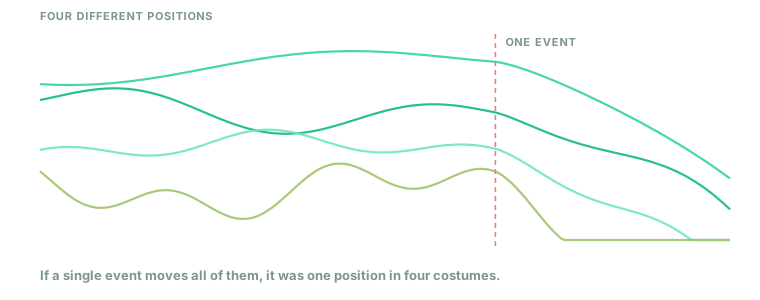
Correlation is the second, and the one most often missed. Holdings in different companies are not diversified if they depend on the same interest rate, the same sector, or the same customer. Harry Markowitz formalised this in 1952 and won a Nobel for it: portfolio risk is a function of how things move together, not of how risky each one is alone. The practical test is a sentence — name the single event that would hurt all of these at once. If it is easy to name, you own one position in several costumes.
Exits are the third. Both of them — where you take some profit, and where you accept being wrong — decided at entry and recorded. That is the whole of it, and none of it requires you to be at a screen when the market moves.
What automation is and is not for
There is a version of automated trading that promises to find opportunities you would miss. That is a claim about prediction, and it is the part worth being sceptical of wherever you encounter it, here included.
There is a second version that is far less exciting and much better evidenced: automation as an enforcement mechanism. Not choosing better, but doing what you already decided, at a moment when you would rather not. Every finding in this article points at that gap — between the plan and the execution, between the intention and the bad Tuesday — and a machine's total indifference to how the week has gone is the one qualification it unambiguously has.
That is the design myMTree is built on. Bots scan, score and stage against rules you can read, and nothing is placed without your approval — so the automation removes the hesitation without removing the decision. Risk limits, profit-taking and exits are enforced by the system rather than recalled by you. Trading still carries risk, and no rule set removes it. The difference is that the rules do not forget, do not hope, and do not have a bad week.
Free PDF
Download this guide as a PDF
The three tests for whether you have written a rule or an intention, plus the decisions you can make without watching a screen.
myMTree is a research and education platform operated by RV Technology Consulting LLC. This article is general educational information, not investment advice, and not a recommendation to buy or sell any security. It does not account for your circumstances, objectives, or risk tolerance. Investing involves risk, including the possible loss of principal; options carry additional risks and are not suitable for every investor. Consider speaking with a licensed financial adviser before making investment decisions.