
Stock investing, explained properly, for someone starting at zero
No jargon you have to look up, no promises about returns. What a share actually is, how people lose money without noticing, and the three decisions that make up every trade you will ever place.
Most guides to investing are written by people trying to sell you something on the next page, which is why they open with what you could make. This one opens with what you are actually buying, because until that is clear nothing else can be.
It takes about fifteen minutes to read. Nothing in it will tell you what to buy — that is not something a web page can responsibly do, and anyone who does it without knowing your circumstances is selling, not teaching.
1. What a share actually is
A share is a slice of ownership in a business. If a company has divided itself into a hundred million shares and you hold one hundred of them, you own a millionth of that company — a millionth of its factories, its brand, its debts, and whatever profit it makes.
That sounds obvious, but it has a consequence people skip. The price on the screen is not the value of the company. It is the price of the last transaction between two strangers who each thought they were getting the better end of it. Value and price are related over long periods and can be almost unrelated over short ones.
This is why "the price went up, so it must be good" is a mistake with a specific shape: it treats yesterday's transactions as information about tomorrow's business. Sometimes it is. Often it is a crowd reacting to another crowd.
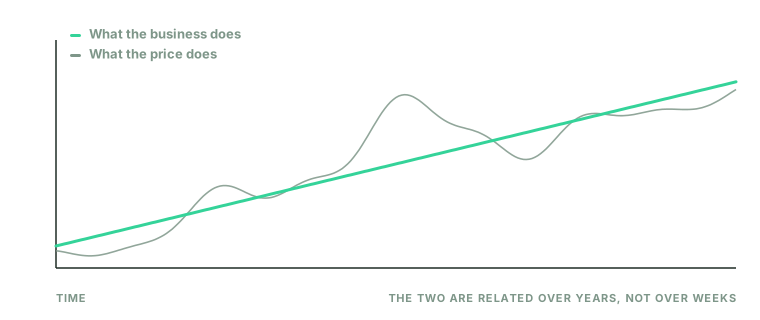
This is the oldest idea in the field. Benjamin Graham — Warren Buffett's teacher at Columbia — built The Intelligent Investor (1949) around an allegory he called Mr. Market: an emotional business partner who quotes you a different price every day, and whose moods are an opportunity rather than a verdict. Graham's point was that the quote tells you what someone feels, and only the business tells you what you own.
What you are actually paid for
Ownership pays you in two ways. The company can hand out part of its profit as a dividend, or it can keep the profit and grow, in which case your slice becomes a slice of something larger. Everything else — the daily movement, the news cycle, the arguments online — is other people changing their minds about which of those two things will happen.
2. The four ways beginners lose money
Almost every loss a new investor takes has one of four causes, and none of them is bad luck.
Owning one idea too heavily
One position large enough to matter is also one position large enough to undo a year. Concentration is how people make money quickly and how they lose it quickly; it is the same property viewed from two directions.
Trading a feeling and calling it a plan
Buying because it is rising, selling because it is falling. Both feel like decisions and neither can be checked afterwards, so neither teaches you anything. Ten years of this produces ten years of the same mistake.
Having no exit for being wrong
A position with no exit rule gets held until it hurts enough to sell, which is reliably the worst moment available. The loss was small once. Nothing forced anyone to act while it still was.
Ignoring what it costs to be busy
Commissions, spreads, and tax on short-term gains are charged on activity, not on being right. A strategy that trades constantly has to clear all of that before it has earned anything at all.
Notice that three of the four are decisions made before anything is bought. The market is not what most people get wrong. Their own process is.
The second and fourth of those are among the most heavily documented findings in household finance. Brad Barber and Terrance Odean's Trading Is Hazardous to Your Wealth (Journal of Finance, 2000) studied tens of thousands of retail brokerage accounts and found that the households which traded most actively earned materially lower net returns than the market — not because their picks were catastrophic, but because activity is charged for and being right is not. Their earlier work identified the disposition effect: investors systematically sell winners and hold losers, which is precisely the behaviour an exit rule exists to prevent.
The pattern holds at the aggressive end too. Barber, Lee, Liu and Odean measured the entire Taiwanese day-trading population and found individual traders losing heavily in aggregate, with those losses accruing to institutions on the other side (Just How Much Do Individual Investors Lose by Trading?, Review of Financial Studies, 2009). Their follow-up on the same market found that only a very small fraction of day traders were predictably profitable, and that this small group tended to be the ones who persisted (The Cross-Section of Speculator Skill, Journal of Financial Markets, 2014). The lesson is not that it is impossible; it is that it is rare, and that assuming you are in that fraction before you have evidence is expensive.
Why the losing behaviour is so consistent was answered elsewhere. Daniel Kahneman and Amos Tversky's prospect theory (Econometrica, 1979) showed that losses are felt roughly twice as intensely as equivalent gains — which is why holding a losing position feels like patience and closing it feels like defeat. Kahneman received the Nobel Memorial Prize in Economics in 2002. You are not weak-willed; you are running standard human software in an environment it was not written for.
3. The three decisions inside every trade
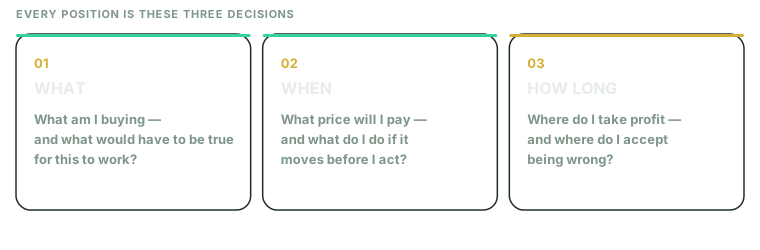
Strip away the vocabulary and every position anyone has ever taken is three decisions: what, when, and how long. Most people answer the first, improvise the second, and never consciously make the third.
What — and what would have to be true
"It's going up" is a prediction. Predictions cannot be checked afterwards, which is precisely what makes them comfortable. A reason can be checked, and being checkable is the only property that makes a decision capable of teaching you anything.
Before buying, write one sentence that could turn out false: what specifically has to happen for this to work. Then write the counterpart — what would tell you that you were wrong. If nothing could, you have not made a decision. You have made a wish with money attached.
When — and what if it moves first
Nobody buys the bottom. Trying to is how people spend entire years in cash waiting for a moment that is only ever obvious afterwards. The useful question is not whether this is the perfect moment but whether your reason still holds at today's price — and what you will do if the price moves before you act.
Decide that in advance: a price you are willing to pay, and a rule for what happens if it never gets there. Buying in two or three parts instead of one costs a little more and removes the need to be right about a particular day. Deciding in the moment is how a plan becomes a chase.
How long — and what makes you sell
This is the decision almost everyone skips and the one that determines the outcome. You need two exits, both chosen while you are calm.
One for being right: a point where you take some profit off the table, so that a position which worked cannot quietly round-trip back to where it started. Trimming a winner is not timidity — it is the reason your winners still count at the end of the year.
One for being wrong: a point where you accept the loss while it is still small enough to be a lesson rather than a wound. Set it as a rule, not as a feeling, because feelings move down with the price. And be clear about what should change your mind: new information about the business is a reason to rethink. A falling price on its own is not new information — it is the event you already planned for.
4. Time horizon changes everything
The same company can be a good long-term holding and a poor short-term one, and both statements can be true at once, because they are answers to different questions. Over years, ownership tends to track how the business does. Over days, it tracks how people feel about how the business might do.
So decide which game you are playing before you buy, not after it goes against you. The most common unforced error in investing is entering with a short-term reason, watching it fail, and reclassifying the position as a long-term holding to avoid taking the loss. That is not patience. It is a losing trade wearing a longer coat.
5. Risk is a thing you decide, not a thing that happens
Beginners tend to treat risk as weather — something the market does to them. In practice most of the risk in a portfolio is chosen at the moment of purchase, through position size, through how correlated the holdings are, and through whether an exit exists.
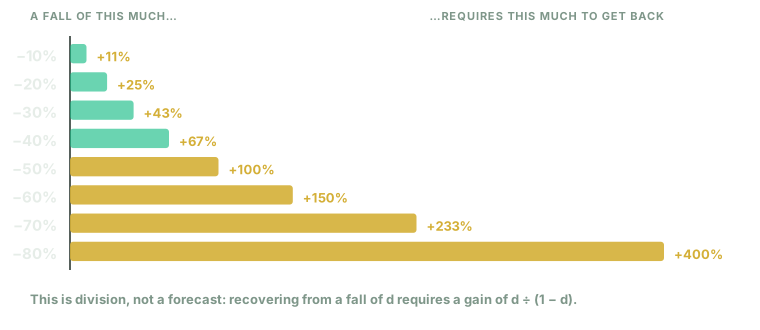
How much this matters is easy to underestimate. Hendrik Bessembinder's Do Stocks Outperform Treasury Bills? (Journal of Financial Economics, 2018) examined every US common stock from 1926 to 2016 and found that the majority of individual stocks underperformed one-month Treasury bills over their lifetimes, and that the entire net wealth creation of the US stock market traced to a very small minority of companies. Owning a handful of names is not a smaller version of owning the market. It is a different bet, with a much wider range of outcomes.
Two positions in different companies are not diversification if both depend on the same interest rate, the same customer, or the same sector. Correlation is what makes a portfolio that looks spread out behave like a single bet in the one week it matters.
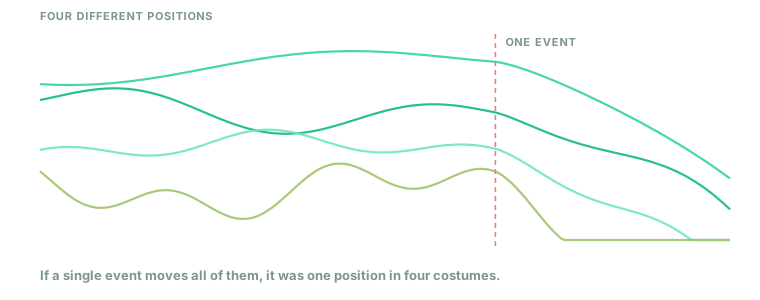
The formal version of this is Harry Markowitz's Portfolio Selection (Journal of Finance, 1952), which showed that the risk of a portfolio depends on how its holdings move together, not merely on the risk of each holding. It won him a share of the 1990 Nobel. Ray Dalio, who built Bridgewater into the largest hedge fund in the world, has described the same principle in plainer terms — that combining enough genuinely uncorrelated return streams is the closest thing to a free lunch that investing offers.
And leverage — borrowing to hold more than you have, which is what margin and many options positions amount to — does not merely magnify outcomes. It changes them in kind, because it can force you out of a position at the worst moment regardless of whether your reasoning was sound. A conclusion you never get to see tested is not the same as being wrong.
Jesse Livermore, the most celebrated speculator of the early twentieth century and the model for Reminiscences of a Stock Operator (1923), made and lost several fortunes doing exactly this, and died bankrupt. Nassim Nicholas Taleb's work on tail risk makes the same argument formally: a strategy with a positive average return and a non-trivial chance of ruin does not have a positive average return, because you only get to run it until the first time it ends.
6. Why knowing all this is not enough
Everything above is easy to agree with in a quiet moment and hard to execute in a loud one. That is not a character flaw and more willpower is not the answer. The rules have to be applied on your worst day — when the position is down, when the reasoning has quietly rearranged itself into hope, and when doing nothing feels like patience rather than paralysis.
There are only three honest responses to that. Write the rules down while you are calm, so the decision was made by a version of you who was not frightened. Practise where being wrong costs nothing, so the first time you experience a losing position is not also the first time you have real money in one. And let something other than your nerve enforce the exits.
This is where practitioners converge most sharply. Jack Schwager interviewed dozens of exceptional traders for Market Wizards (1989) and its sequels; the interviewees disagreed about almost everything — timeframes, instruments, whether to use charts at all — and agreed on risk management and predefined exits. Paul Tudor Jones, who has run Tudor Investment Corporation since 1980, told Schwager that his focus is defensive rather than offensive: protecting what he has, on the basis that he assumes every position he holds might be wrong.
Peter Lynch, who ran Fidelity's Magellan Fund from 1977 to 1990, put the same discipline the other way round — that selling your winners while keeping your losers is like pulling out the flowers and watering the weeds. And Richard Dennis settled the question of whether any of it is teachable: in the 1980s he recruited a group of beginners, taught them a written rule set, and the Turtle experiment produced traders who could follow it. Rules are transferable. The temperament to apply them under pressure is what has to be built.
One caveat worth stating plainly, because most marketing omits it: these people are cited here for the reasoning they converged on, not as evidence that their results are repeatable. Survivorship runs through every list of famous traders — the ones who took identical risks and were wrong do not get interviewed. Livermore is in this article precisely because he is the counterexample.
Where to start
If you have never placed a trade, do not begin by placing one. Begin by writing down what you would buy, why, at what price, and what would make you sell — then watch what actually happens to that decision over the following weeks. It is the cheapest tuition available, and almost nobody pays it.
That is what a paper account is for. Every myMTree account starts on a paper ledger with real market data and no money at stake: real portfolio performance, real mistakes, no cost. You apply the three decisions, see what your own judgement would have done, and learn the part that reading cannot teach.
Sources and further reading
Everything cited above, in the order it appears. Academic papers are freely findable by title; the books are widely available in libraries.
The books
- Benjamin Graham — The Intelligent Investor (1949)Price versus value, Mr. Market, margin of safety. Start with chapters 8 and 20.
- Edwin Lefèvre — Reminiscences of a Stock Operator (1923)The Livermore account. Now in the public domain in the United States.
- Peter Lynch — One Up on Wall Street (1989)Know what you own, and why.
- Jack Schwager — Market Wizards (1989)Where the interviewees disagree about everything except risk.
The research
- Markowitz — Portfolio Selection (1952)Journal of Finance. Portfolio risk depends on how holdings move together.
- Kahneman & Tversky — Prospect Theory (1979)Econometrica. Losses register roughly twice as strongly as equivalent gains.
- Barber & Odean — Trading Is Hazardous to Your Wealth (2000)Journal of Finance. Activity is charged for; being right is not.
- Barber, Lee, Liu & Odean — Individual Investor Losses (2009)Review of Financial Studies. The whole Taiwanese market, measured.
- Bessembinder — Do Stocks Outperform Treasury Bills? (2018)Journal of Financial Economics. Most individual stocks did not.
On risk and ruin
- Nassim Nicholas Taleb — Fooled by Randomness (2001)Why an average outcome misleads when ruin is on the table.
- Ray Dalio — Principles (2017)Uncorrelated return streams as the closest thing to a free lunch.
- Michael Batnick — Big Mistakes (2018)The losses taken by investors we now treat as infallible. Read it after a good run.
Free PDF
Take this guide with you
The whole article as a PDF, including the figures and the full source list. One email, no follow-up sequence you did not ask for.
myMTree is a research and education platform operated by RV Technology Consulting LLC. This article is general educational information, not investment advice, and not a recommendation to buy or sell any security. It does not account for your circumstances, objectives, or risk tolerance. Investing involves risk, including the possible loss of principal. Consider speaking with a licensed financial adviser before making investment decisions.