
What diversification actually requires
Owning twenty things is not diversification if they all depend on the same thing. What correlation means, why it rises exactly when you need it not to, and what can be done about it.
Diversification is the most agreed-upon idea in investing and one of the most commonly misapplied, because the popular version — own a lot of different things — leaves out the part that does the work.
1. Count is not the measure. Correlation is.
Harry Markowitz showed in 1952 that the risk of a portfolio is not the average of the risks of its holdings. It depends on how those holdings move in relation to one another. Two positions that rise and fall together are, for risk purposes, close to one position held twice. Two that move independently genuinely reduce the range of outcomes. The insight won a share of the 1990 Nobel and is the foundation of essentially all portfolio theory since.
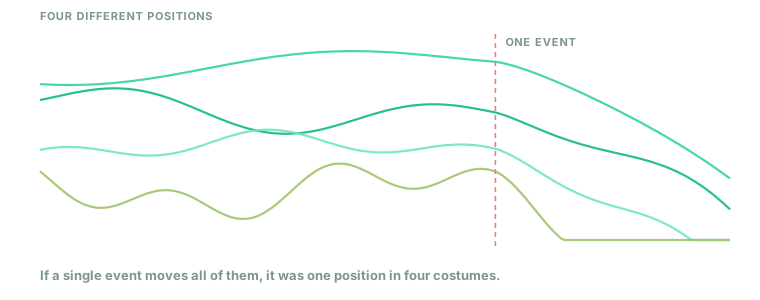
The practical test takes one sentence. Name the single event that would damage everything you hold at once. If that sentence is easy to write — a rate rise, one sector cooling, one large customer, one currency — then you own one position wearing several costumes, however many line items the account shows.
2. Correlation rises exactly when you need it not to
This is the part that surprises people, and the reason diversification disappoints precisely when it is most needed. In ordinary conditions, holdings across different sectors and regions do move somewhat independently. In a severe market-wide event they tend to move together, because the thing driving them is no longer anything about the individual businesses — it is a general withdrawal from risk, and it hits everything held by the people doing the withdrawing.
The consequence is that a portfolio's measured diversification, calculated over a calm period, systematically overstates the protection it will provide in a crisis. Planning on the calm-period number is planning for the weather you have already had.
3. What genuinely diversifies
Different drivers, not different names
Holdings whose fortunes depend on genuinely different things: different customers, different input costs, different regulatory regimes, different points in the economic cycle. Ask what each one needs in order to do well. If the answers rhyme, the diversification is cosmetic.
Different asset classes
Government bonds, cash, property and commodities respond to different forces than company shares do, and historically have not moved in lockstep with them. Historically is doing real work in that sentence — these relationships have shifted before and can shift again, particularly when inflation is the driving force.
Different time horizons
Positions that are supposed to work over different periods are not competing for the same conditions. A holding meant for a decade and a position meant for a month can both be wrong at once, but they are not wrong for the same reason — and you will not close them both on the same bad afternoon.
Ray Dalio, whose firm became the largest hedge fund in the world, has described combining enough genuinely uncorrelated return streams as the closest thing to a free lunch that investing offers — the emphasis being on genuinely, which is where the difficulty lives. Finding things that are actually independent is hard work. Assembling many things that merely look different is easy, and is what most portfolios contain.
4. The other direction: the case against too much spread
Diversification has a cost, and honest coverage says so. Spreading capital across many positions guarantees you will own the poor ones alongside the good, which caps the outcome as surely as it limits the damage. Concentrated portfolios are how large fortunes are made, and — the sentence people leave off — also how they are unmade.
Bessembinder's study of every US common stock from 1926 to 2016 puts a hard edge on this. Most individual stocks underperformed one-month Treasury bills over their lifetimes, and the entire net wealth creation of the market traced to a small minority of companies. Two conclusions follow, and they point in opposite directions: concentration risks missing the few that mattered, and broad ownership guarantees holding them. Which trade-off is right for you is a question about your circumstances, which is exactly the sort of question a web page cannot answer for you.
5. What to actually do
Write down, for each holding, the one thing it depends on. Not the company description — the dependency. Then look at the list. If several entries are the same word, that is your real position count, and it is smaller than the number of rows in your account.
Then decide the size of each position on the basis of that real count rather than the apparent one. This costs nothing, takes twenty minutes, requires no software, and is the single most useful hour of portfolio work available to a beginner.
Free PDF
Download this guide as a PDF
Including the one-sentence correlation test and the three kinds of spread that genuinely reduce risk.
The research
- Markowitz — Portfolio Selection (1952)Journal of Finance. Where correlation entered portfolio construction.
- Bessembinder — Do Stocks Outperform Treasury Bills? (2018)Journal of Financial Economics. Ninety years of every US stock.
Worth reading
- Ray Dalio — Principles (2017)On uncorrelated return streams.
- Michael Batnick — Big Mistakes (2018)On what concentration did to people who could afford it.
myMTree is a research and education platform operated by RV Technology Consulting LLC. This article is general educational information, not investment advice, and not a recommendation to buy or sell any security. It does not account for your circumstances, objectives, or risk tolerance. Investing involves risk, including the possible loss of principal. Consider speaking with a licensed financial adviser before making investment decisions.