
The hidden costs in trading
Commission is the one people check and usually the smallest. The spread, slippage, borrowing costs and tax are charged on activity — which means they are charged whether or not you were right.
"Zero commission" is true and beside the point. A trade has several costs and the visible one is rarely the largest. None of them depends on whether the position works, which is the property that makes them so damaging: a strategy has to clear the whole stack before it has earned anything at all.
This is not a marginal consideration. It is the leading explanation offered by the research for why active retail traders underperform. Barber and Odean found the most active households earning materially lower net returns than the market, driven by turnover and its costs rather than by catastrophically bad selection. The Taiwanese study measured the same effect across an entire national market.
The five costs, in the order people notice them
1. Commission — the one on the screen
Often zero now for shares, rarely zero for options, and almost never zero once you count what replaced it. Worth checking, and usually the least of it.
2. The spread — the gap you cross
At any moment there is a price to buy and a lower price to sell. You cross that gap on the way in and again on the way out. It is not itemised anywhere, and on thinly traded instruments and on options it is frequently the largest single cost of the trade.
3. Slippage — the price you did not get
The difference between the price you saw and the price you were filled at. Small in calm conditions and in large, liquid instruments; considerably worse at the open, on news, and in exactly the fast conditions where people most often trade.
4. Financing and borrowing
Margin interest on borrowed money, borrowing fees on short positions, and the cost of carry embedded in derivatives. These accrue with time rather than with activity, which makes them easy to forget in a position that is going nowhere.
5. Tax drag — the cost of being right
In many jurisdictions, gains realised quickly are taxed more heavily than gains held longer. Frequent trading can therefore convert a given pre-tax result into a materially smaller after-tax one, and this is charged only when you win — which is why it is so easy to leave out of the plan.
Why this compounds against you
Each cost is small enough to dismiss individually. The problem is that they are charged per trade, so they scale with activity, while skill does not. Doubling how often you trade roughly doubles the cost stack and does not double your edge — and for most people there is no measured edge to double in the first place.
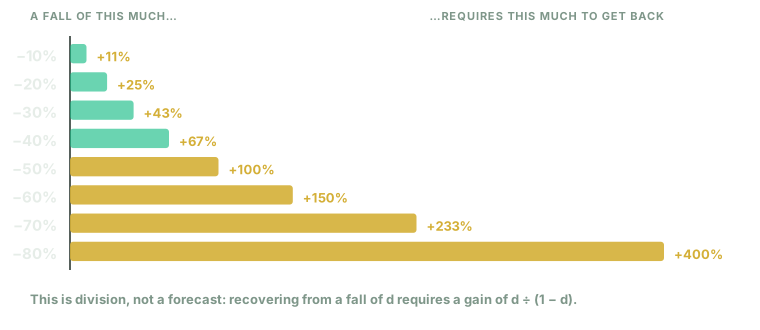
This is why the number of trades is itself a risk decision, and why almost every advertisement promising more opportunities is describing a cost increase in language that sounds like an improvement.
What to do about it
Count the costs into the plan rather than discovering them afterwards. Before a trade, estimate the round-trip cost — both spread crossings, commission, and any financing if you will hold it a while — and ask whether the move you are expecting is comfortably larger than that. If it is not, the trade needed to be right by an implausible margin just to break even.
Prefer liquid instruments while you are learning, because the spread and the slippage are both smaller and more predictable there. Use resting orders rather than market orders when nothing forces you to act immediately. And treat every increase in trading frequency as what it is: a decision to spend more, in exchange for a hoped-for edge that has not been demonstrated yet.
The paper ledger will not teach you this one on its own — a simulated fill does not charge you a spread the way the market does. What it will teach you is how often you want to trade, which is the input that decides how much all of this costs.
Free PDF
Download this guide as a PDF
The five costs and the round-trip estimate to run before a trade, in a form you can keep.
The research
- Barber & Odean — Trading Is Hazardous to Your Wealth (2000)Journal of Finance. Turnover and costs, not stock selection.
- Barber, Lee, Liu & Odean — Individual Investor Losses (2009)Review of Financial Studies. The same effect, national scale.
- Bessembinder — Do Stocks Outperform Treasury Bills? (2018)Journal of Financial Economics. On what you are up against before costs.
Worth reading
- Jack Schwager — Market Wizards (1989)On why the professionals talk about costs and defence rather than picks.
myMTree is a research and education platform operated by RV Technology Consulting LLC. This article is general educational information, not investment advice, and not a recommendation to buy or sell any security. It does not account for your circumstances, objectives, or risk tolerance. Investing involves risk, including the possible loss of principal. Consider speaking with a licensed financial adviser before making investment decisions.