
What a paper trading account is actually for
Not a demo, and not a game. It is the only place you can find out what you do under pressure while the answer is still free.
Almost everyone treats a paper account as a tutorial — a sandbox to click around in until the real thing starts. That misunderstands what it is good at. A paper account is poor at teaching you how a platform works, which takes an afternoon. It is unusually good at teaching you something you cannot learn any other way without paying for it: what you actually do when a position goes against you.
That is the expensive lesson. Everything else in investing can be read. This one has to be lived, and it costs nothing to live it here.
The gap between what you plan and what you do
Ask anyone before they invest what they will do if a holding falls sharply, and they will describe a calm, sensible response. Watch what they actually do and the answer is frequently different — they hold, they add to it, they stop looking at the account. This is not a failure of intelligence. It is loss aversion, the finding at the centre of Kahneman and Tversky's prospect theory (Econometrica, 1979): losses register roughly twice as strongly as equivalent gains, which makes closing a losing position feel like an admission and holding it feel like fortitude.
Terrance Odean documented the consequence directly in Are Investors Reluctant to Realize Their Losses? (Journal of Finance, 1998) — the disposition effect, in which investors sell winners and keep losers at a rate no rational model explains. You will do this too. The only useful question is whether you discover it on a paper account or on your savings.
Four things worth doing on paper before anything is real
Write the reason before you enter
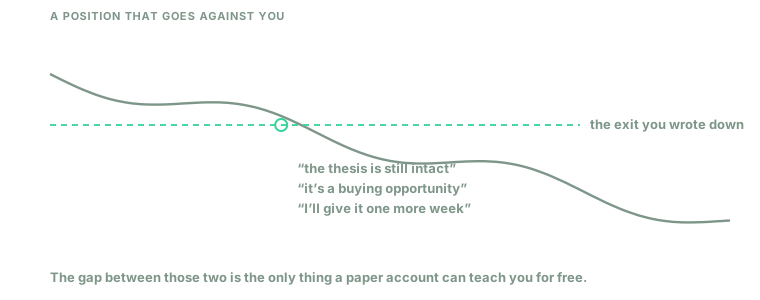
One sentence that could turn out false, and one that says what would prove you wrong. Then leave it alone. Weeks later, read what you wrote and compare it with what you did. The gap between those two is the thing you are actually training.
Sit through a real drawdown
Not a simulated shock — an ordinary bad fortnight in a position you chose and believed in. Notice what you want to do on day nine. That impulse is the one your rules exist to overrule, and you cannot write rules against an impulse you have never felt.
Test whether your reasoning survives contact
Most beginner strategies work in the imagination because they are never specified tightly enough to fail. Made concrete — this entry, this exit, this size — they either produce decisions or they dissolve. Both results are useful; the second is cheaper here.
Find your real position size
Not the one that sounds reasonable, but the one you can hold without checking the price at eleven at night. Almost everyone's honest answer is smaller than their planned answer, and finding that out on paper costs nothing.
Where paper trading misleads
Being straight about the limits is what makes the exercise worth anything. Three of them matter.
The first is emotional. Paper losses do not hurt, and the hurt is a variable in the equation. Someone who is disciplined on paper is not yet proven to be disciplined with money at stake — they have only proven they are not undisciplined in the absence of pressure, which is a lower bar. Treat a clean paper record as a licence to start small, not as a licence to start big.
The second is mechanical. A simulated fill assumes someone was there to take the other side at the price you wanted. In liquid, ordinary conditions that is close enough to true. In thin instruments, at the open, or during a shock, it can be materially wrong — and those are exactly the moments a strategy is likely to depend on. Discount results that rely on precise fills.
The third is selective. It is easy to run ten paper strategies, remember the one that worked, and call it a validated method. This is survivorship bias operating on a sample of one person. Barber and Odean's work on retail accounts (Journal of Finance, 2000) found active traders underperforming largely through costs and turnover — not through a shortage of ideas that looked good at the time.
How long is long enough
There is no correct number of weeks, and anyone offering one is guessing. The honest test is not duration but coverage: have you held a position through a period when you were wrong, taken the exit you wrote down in advance, and done it more than once without persuading yourself the rule did not apply this time? Until that has happened, the account has not tested anything. Once it has, you have evidence about yourself that no amount of reading provides.
Richard Dennis's Turtle experiment in the 1980s is the strongest evidence that this is trainable at all. He recruited people with no trading background, gave them a written rule set, and produced traders who could follow it — while also demonstrating the failure mode, since the ones who deviated under pressure performed worst. The rules were never the scarce ingredient. Executing them on a bad day was.
What this looks like here
Every myMTree account starts on a paper ledger with real market data and nothing at stake — real portfolio performance, real mistakes, no cost. It is not a trial that expires into a sales call. It is the first stage of the platform, and the stage where the three decisions in the previous guide stop being theory.
Free PDF
Download this guide as a PDF
Including the four things worth doing on paper, as a checklist you can keep beside the account.
myMTree is a research and education platform operated by RV Technology Consulting LLC. This article is general educational information, not investment advice, and not a recommendation to buy or sell any security. It does not account for your circumstances, objectives, or risk tolerance. Investing involves risk, including the possible loss of principal; options carry additional risks and are not suitable for every investor. Consider speaking with a licensed financial adviser before making investment decisions.